
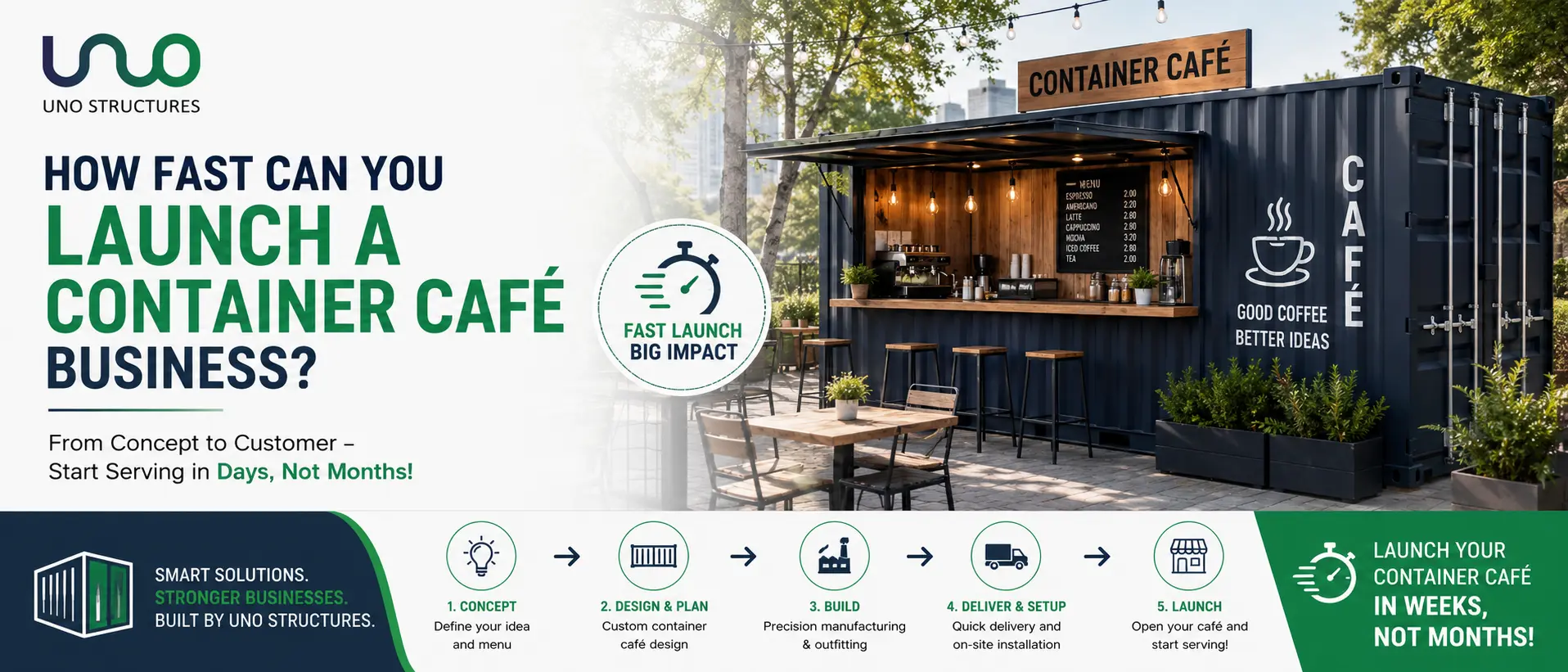
How Fast Can You Launch a Container Café Business?
The idea of a café built inside a shipping container once felt experimental. Today, it sits somewhere between hospitality, architecture, and rapid commercial infrastructure. What changed was not only aesthetics, but economics. Businesses increasingly want spaces that can be deployed quickly, adapted easily, and operated with lower construction dependency.
That shift explains why the Container Cafe model is now appearing across highways, urban retail zones, campuses, industrial townships, tourism projects, and event-led commercial developments.
In many cases, the appeal is not simply portability. It is predictability.
Traditional cafe construction often involves layered approvals, prolonged civil work, weather-related delays, and fluctuating labor availability. Portable structures reduce many of those variables by shifting a significant portion of fabrication into controlled manufacturing environments.
For businesses evaluating launch timelines, that difference matters more than appearance alone.
Industry Context & Market Positioning
The café industry has gradually moved toward modular deployment formats. Quick-service brands, independent café operators, franchise chains, and experiential food startups are all experimenting with smaller-footprint commercial spaces.
Container-based cafés fit this transition because they align with three broader market realities:
- Faster commercial deployment cycles
- Rising urban land utilization pressure
- Increasing demand for relocatable retail formats
In industrial manufacturing, modular thinking is already common. Warehouses, control rooms, portable cabins, and prefabricated units have long prioritized speed and repeatability. The café segment is now borrowing similar principles.
What many first-time buyers misunderstand is that a container cafe is not merely a painted shipping box with furniture added later. The operational quality depends heavily on engineering integration:
- Thermal insulation
- Electrical routing
- Ventilation planning
- Structural reinforcement
- Moisture control
- Food-service workflow design
These details often determine whether the café remains functional after several monsoon cycles or becomes maintenance-heavy within a short period.
Manufacturers such as UNO Structures, which operate within portable infrastructure and prefabricated construction segments, typically approach these projects more like engineered modular systems rather than temporary kiosks.
Businesses exploring regional deployment options can also review the company’s operational footprint through its presence network across India.
What Is a Container Cafe?
A container cafe is a modular food and beverage outlet developed using modified shipping containers or fabricated steel container structures. These cafés are designed for faster installation, portability, controlled manufacturing, and flexible commercial deployment across urban, highway, retail, tourism, and event-based environments.
Unlike conventional brick-and-mortar cafés, container cafés are largely prefabricated off-site. Electrical systems, insulation, interiors, plumbing, counters, and structural modifications are integrated during manufacturing, reducing on-site construction time and improving deployment efficiency.
How Fast Can a Container Café Be Launched?
In practical terms, a container café can often become operational within a few weeks once design approvals, utility planning, and fabrication schedules are finalized.
However, launch speed depends on several variables:
Factor |
Influence on Timeline |
|
Container size and layout complexity |
Larger multi-container units require longer structural integration |
|
Interior customization |
Kitchen equipment and premium finishes extend production |
|
Site readiness |
Foundation and utility availability affect installation |
|
Local permissions |
Municipal approvals vary by location |
|
HVAC and insulation requirements |
Climate-specific engineering increases fabrication stages |
|
Transportation logistics |
Interstate delivery schedules influence deployment |
A relatively standardized single-container café may move from fabrication to installation much faster than a traditional commercial structure.
Still, experienced buyers generally focus less on “fastest delivery” claims and more on operational readiness. A café that launches quickly but suffers from ventilation problems, overheating, drainage issues, or electrical instability often creates larger business interruptions later.
Technical Specifications & Key Features
Container cafés vary considerably depending on intended use environments. A highway coffee outlet, for example, has different operating conditions compared to a rooftop urban café.
Some common technical considerations include:
Structural Framework
- Mild steel or corten steel container base
- Reinforced openings for doors and serving windows
- Additional load-bearing support for rooftop seating or signage
Thermal Management
- PUF insulation
- Rockwool insulation
- Interior cladding systems
- Reflective roofing coatings
Thermal control becomes especially important in Indian climatic conditions where prolonged heat exposure can affect indoor comfort and equipment efficiency.
Utility Integration
- Concealed electrical wiring
- Water inlet and drainage systems
- Kitchen exhaust routing
- HVAC integration
- Lighting systems
Interior Functional Planning
- Barista workflow movement
- Storage optimization
- Customer queue management
- Compact equipment integration
One recurring issue in poorly designed container cafés is inadequate circulation planning. Compact commercial spaces demand highly intentional layouts. Even a few inches of counter placement can affect operational efficiency during peak serving hours.
Materials & Production Methodology
The manufacturing process behind a container café is closer to industrial fabrication than conventional interior decoration.
Typically, the workflow includes:
- Structural assessment and base preparation
- CNC cutting and opening fabrication
- Reinforcement welding
- Surface treatment and anti-corrosion coating
- Insulation installation
- Electrical and plumbing integration
- Interior paneling and flooring
- Fixture and furniture installation
- Quality inspection and dispatch preparation
Common Material Components
|
Component |
Typical Material |
|
Structural shell |
Mild steel / corten steel |
|
Flooring |
Vinyl, cement board, anti-skid surfaces |
|
Interior walls |
PVC panels, gypsum, ACP |
|
Insulation |
PUF, rockwool, glass wool |
|
Exterior finish |
Powder coating, PU paint, weather coatings |
An important distinction exists between marine shipping containers and fabricated container structures. While both may visually resemble each other, their structural behavior, corrosion resistance, dimensional flexibility, and fabrication adaptability can differ significantly.
Experienced manufacturers usually evaluate:
- Intended lifespan
- Mobility frequency
- Climate exposure
- Occupancy load
- Utility integration requirements
before finalizing the fabrication approach.
Performance & Durability Insights
Durability in a container café is rarely determined by steel thickness alone.
Long-term performance usually depends on how well multiple systems work together:
- Corrosion protection
- Waterproof sealing
- Ventilation management
- Insulation continuity
- Load distribution
- Fabrication precision
For example, condensation control is often overlooked. In humid regions, inadequate insulation and poor ventilation can create internal moisture accumulation, eventually affecting interiors, electrical systems, and customer comfort.
Similarly, transportation stresses matter. Portable structures exposed to repeated relocation require stronger reinforcement around openings and connection points.
Key Durability Indicators
- Weld quality consistency
- Anti-rust surface treatment
- Proper roof slope management
- Weather-sealed joints
- High-quality insulation layering
- Stable electrical load planning
This is one reason industrial-grade fabrication environments generally produce more reliable portable commercial units compared to ad-hoc on-site modifications.
Applications & Use Environments
Container cafés are now being deployed across a wide range of commercial environments:
Urban Retail
Compact café setups near office clusters and high-footfall zones.
Highway & Transit Corridors
Quick-deployment food service formats for travelers.
Educational Campuses
Controlled-space beverage and snack outlets.
Tourism & Resorts
Experiential cafés integrated into scenic environments.
Industrial & Corporate Campuses
Employee refreshment zones within manufacturing or business parks.
Events & Temporary Commercial Installations
Portable food service during exhibitions, concerts, and seasonal events.
Interestingly, portability itself is not always the primary driver. In many urban projects, businesses select modular café formats because they reduce prolonged site disruption and enable more controlled budgeting.
Container Café Variants: A Neutral Comparison
Different container café configurations serve different operational goals.
Type |
Suitable Use Case |
Key Observation |
|
Single Container Café |
Compact beverage outlets |
Faster deployment and lower space requirement |
|
Double Container Café |
Larger seating capacity |
Better customer circulation |
|
Open Deck Container Café |
Experiential hospitality spaces |
Higher aesthetic appeal but weather dependency |
|
Foldable Modular Café |
Temporary deployments |
Easier transport flexibility |
|
Multi-Level Container Cafe |
Premium destination cafés |
Requires advanced structural engineering |
No single variant is universally “best.” The correct choice depends on:
- Customer volume
- Mobility requirements
- Climate exposure
- Site constraints
- Utility availability
- Long-term operational plans
Buyer Evaluation Checklist
Before selecting a container café manufacturer or supplier, buyers often evaluate the following:
Structural & Technical
- Steel grade and thickness
- Reinforcement methodology
- Insulation specification
- Waterproofing approach
- Electrical load capability
Operational
- Kitchen ventilation planning
- Maintenance accessibility
- Workflow efficiency
- Utility integration readiness
Manufacturing Capability
- In-house fabrication infrastructure
- Production quality consistency
- Delivery coordination
- Pan-India logistics capability
Commercial Considerations
- Future relocation feasibility
- Scalability for multiple units
- Repair and servicing accessibility
One practical observation from modular infrastructure projects is that lower initial fabrication cost can sometimes lead to significantly higher operational maintenance later.
Frequently Asked Questions
1. How long does it take to build a container café?
A standard container café may take a few weeks for fabrication and installation depending on customization level, utility integration, and site readiness. Complex multi-container cafés usually require longer engineering and production timelines.
2. Are container cafés suitable for Indian weather conditions?
Yes, provided proper insulation, ventilation, waterproofing, and corrosion protection systems are integrated during manufacturing. Climate-responsive fabrication is important for long-term performance.
3. Can a container café be relocated later?
Most container cafés are designed with portability in mind. However, frequent relocation requires additional structural reinforcement to handle transportation stresses safely.
4. What materials are commonly used in container cafés?
Container cafés generally use steel structural frameworks combined with insulation materials, interior cladding systems, weather-resistant coatings, and commercial-grade utility integration components.
5. Do container cafés require civil construction work?
Minimal site preparation is usually required compared to traditional construction. Foundation needs depend on unit size, soil conditions, and intended permanence of installation.
Supply & Distribution Capability
As modular commercial infrastructure demand expands across India, manufacturers increasingly operate through centralized fabrication supported by regional logistics coordination.
Delhi continues to remain a significant manufacturing and distribution hub because of its connectivity to northern, western, and central Indian markets.
Companies like UNO Structures work within portable structure and prefabricated infrastructure segments supplying projects across multiple regions. For buyers operating in multiple cities, consistent fabrication standards and coordinated transport logistics often become as important as design itself.
From a procurement perspective, the reliability of manufacturing workflows usually matters more than aggressive delivery promises.
Conclusion
The growing popularity of the Container Cafe format reflects a broader change in how commercial spaces are being developed. Businesses increasingly prioritize adaptability, deployment speed, operational efficiency, and controlled construction processes.
Yet speed alone should not define procurement decisions.
A well-engineered modular café balances fabrication quality, thermal performance, durability, workflow planning, and long-term maintainability. Those factors ultimately influence operational stability more than launch timelines alone.
If you are evaluating this product for an upcoming project, reviewing specifications, insulation systems, fabrication methodology, and intended operating conditions carefully can help reduce procurement risks. For additional technical guidance or project discussions, you can connect with the team at Uno Structures Contact Page.