
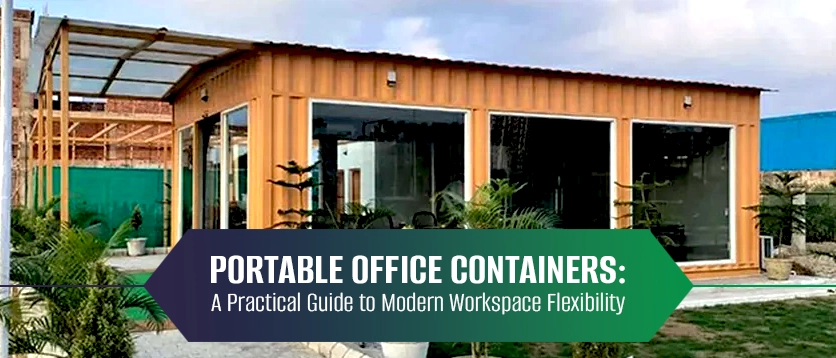
Portable Office Containers: A Practical Guide to Modern Workspace Flexibility
When Traditional Offices Stop Making Sense
You’ve probably seen it happen on project sites or even outside growing industrial units—teams working out of makeshift cabins, temporary sheds, or rented spaces that never quite fit the need. Delays in construction, rising lease costs, or the need to mobilize quickly often leave businesses in a strange in-between phase.
This is where the idea of a ready-to-deploy office starts making real sense. Not permanent, not makeshift—something in between that works from day one.
Portable office containers have quietly become that solution for businesses that value speed, flexibility, and operational control.
What Are Portable Office Containers?
Portable office containers are prefabricated, modular workspace units built using repurposed or custom-fabricated containers, designed to function as fully operational offices that can be transported and installed at different locations with minimal setup time.
Portable Office Containers Explained Differently
Think of them as plug-and-play office spaces. Instead of constructing a building from scratch, these units come pre-built with walls, insulation, electrical fittings, and interiors—ready to be deployed wherever your operations require a functional workspace.
Why Businesses Are Shifting Toward Portable Office Setups
The shift isn’t random—it’s driven by real operational challenges.
1. Speed of Deployment
In many industries, waiting months for office construction isn’t practical. Portable setups can be installed in days.
2. Mobility
Projects move. Sites change. Teams relocate. A portable office moves with your business.
3. Controlled Costs
Instead of long-term lease commitments or unpredictable construction costs, businesses get a more predictable setup.
4. Temporary but Professional
Unlike ad-hoc arrangements, these units provide structured, organized working environments.
5. Scalability
Need more space later? Additional units can be added without redesigning everything.
Who Should Consider Portable Office Containers (and Who Shouldn’t)
Ideal For:
- Construction and infrastructure companies
- Manufacturing units with expanding operations
- Mining and oil & gas field teams
- Logistics hubs and warehouse offices
- Event management teams needing temporary offices
- Government or NGO field operations
Not Ideal For:
- Businesses requiring permanent architectural identity (e.g., corporate headquarters)
- High-rise urban office setups with strict zoning limitations
- Operations needing highly customized structural compliance beyond modular capabilities
In simple terms, if flexibility matters more than permanence, this solution fits.
How Portable Office Containers Work in Practice
Understanding the real-world workflow helps avoid confusion.
Step 1: Requirement Mapping
- Size (number of people)
- Usage (admin office, site office, meeting room)
- Facilities (AC, washroom, partitions)
Step 2: Design & Customization
- Interior layout planning
- Electrical fittings
- Ventilation and insulation adjustments
Step 3: Fabrication
- Container modification
- Structural reinforcement
- Finishing and installation of components
Step 4: Transportation
- Delivered via truck to the required site
Step 5: Installation
- Positioned using cranes or hydraulic systems
- Minimal groundwork required
Step 6: Operational Setup
- Power connection
- Furniture installation
- Ready for use
For a deeper understanding of how these solutions are structured and used in real-world applications, you can explore the detailed overview of portable office container solutions.
What Typically Goes Inside These Units?
Depending on use-case, portable offices can include:
- Workstations and desks
- Air conditioning systems
- Lighting and electrical wiring
- Insulated walls and ceilings
- Windows and ventilation systems
- Attached washrooms (optional)
- Storage cabinets
The level of customization often depends on operational needs rather than aesthetics alone.
Key Requirements Before Setting One Up
While these are relatively easy to deploy, a few practical requirements still matter:
Site Conditions
- Flat and stable ground
- Access for delivery vehicles
- Adequate drainage (especially for long-term use)
Utilities
- Electricity connection
- Water supply (if washroom included)
Local Compliance (Varies by Region)
- Temporary structure permissions (in some cases)
- Industrial zoning approvals
- Safety compliance for electrical fittings
In many cases, these units fall under temporary or movable structures, but local regulations can vary.
Common Challenges Businesses Face
1. Underestimating Space Needs
Teams often outgrow the container faster than expected.
2. Poor Ventilation Planning
Especially in hotter climates, inadequate insulation can impact usability.
3. Ignoring Future Expansion
Planning only for current needs can lead to layout limitations later.
4. Site Accessibility Issues
If trucks or cranes can’t reach the site, installation becomes complicated.
5. Compliance Overlook
Even temporary setups may require permissions depending on usage.
Portable Office Containers vs Traditional Office Spaces
|
Aspect |
Portable Office Containers |
Traditional Office |
|
Setup Time |
Days to weeks |
Months |
|
Mobility |
Relocatable |
Fixed |
|
Cost Structure |
Controlled, modular |
Variable, long-term |
|
Customization |
Moderate to high |
High |
|
Permanence |
Temporary / Semi-permanent |
Permanent |
This comparison highlights why portable offices are gaining traction in operational environments rather than corporate settings.
Key Considerations Before Choosing One
Before proceeding, it helps to think beyond immediate needs.
- Will your team size increase soon?
- Is the location temporary or long-term?
- Do you need multiple units connected?
- What climate conditions will the unit face?
- Will the container need relocation later?
These questions shape better decisions than focusing only on size or cost.
Typical Timeline: What to Expect
While timelines vary, here’s a realistic expectation:
- Requirement discussion: 2–5 days
- Design and approvals: 5–10 days
- Fabrication: 2–4 weeks
- Delivery and installation: 2–5 days
Total: Around 3–6 weeks in most cases
Complex customizations may extend this timeline slightly.
Frequently Asked Questions
Are portable office containers legally allowed in India?
In many cases, they are treated as temporary structures, but permissions may depend on land type, usage, and local authority regulations. Industrial zones typically have fewer restrictions compared to urban commercial zones.
How long do portable office containers last?
With proper maintenance and quality materials, these units can last 10–15 years or more, especially when used in stable environments.
Can portable offices be relocated easily?
Yes, they are designed for relocation. However, repeated movement may require structural checks and minor refurbishments.
Do these containers require foundation work?
Usually minimal. A level surface is sufficient, though some sites may use concrete blocks or base supports for stability.
Are they suitable for extreme weather conditions?
With proper insulation, ventilation, and material selection, they can perform well in both hot and cold environments.
When Does Professional Guidance Become Important?
While the concept seems straightforward, execution often isn’t.
You may need expert input when:
- Designing multi-container office layouts
- Ensuring compliance with local regulations
- Planning utilities integration
- Optimizing long-term usability
Understanding how experienced providers approach design and deployment can make a noticeable difference. Learning more about the team behind these solutions—like UNO Structures—can offer useful perspective on how such projects are handled end-to-end.
If your operations span multiple regions, reviewing service availability across locations via their presence across India can also help in planning scalability.
Final Thoughts
Portable office containers are not just a temporary workaround—they’re a strategic choice for businesses that operate in dynamic environments.
They solve a very specific problem: how to create functional, professional workspace infrastructure without the delays and rigidity of traditional construction.
If your business deals with changing sites, expanding operations, or time-sensitive setups, this approach can simplify more than just workspace—it can streamline how your teams function on the ground.
If you’re unsure whether this is the right fit for your situation, it’s always worth discussing your requirements with experienced professionals before making a decision.