
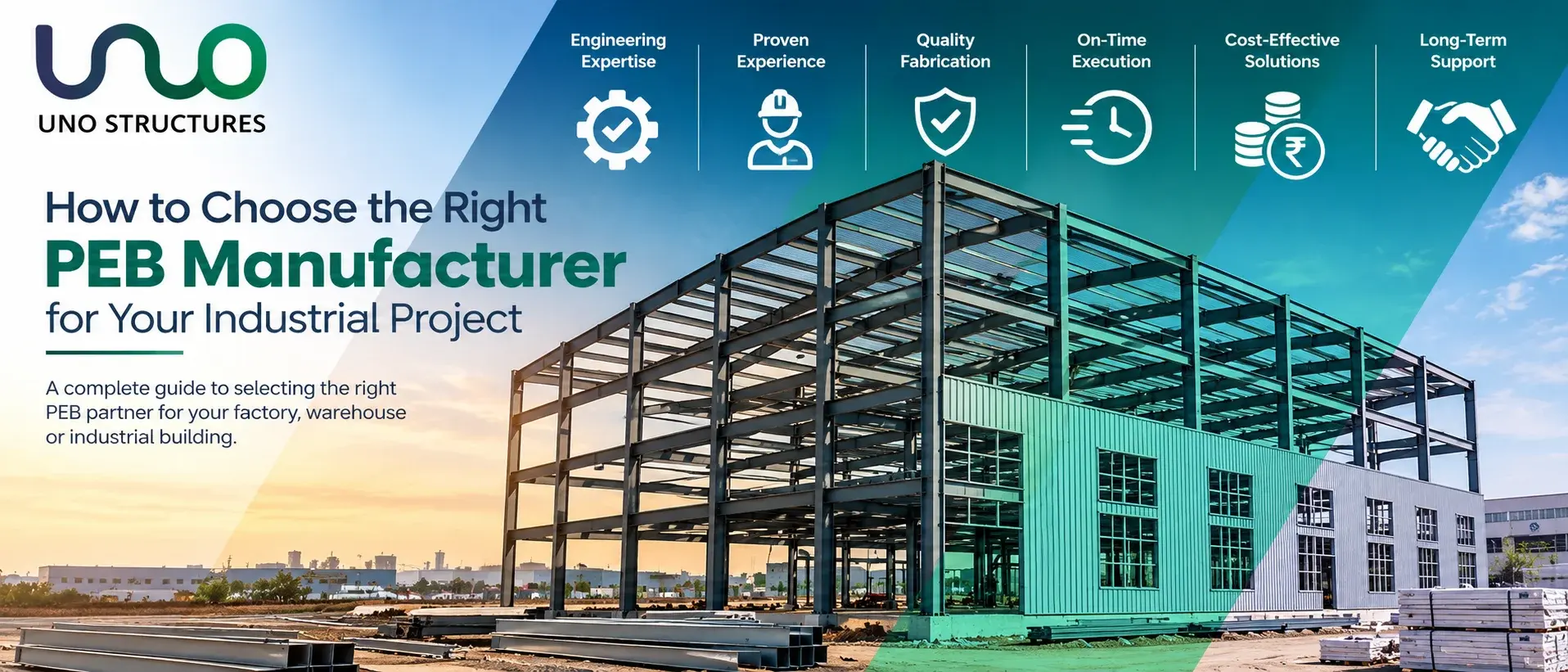
How to Choose the Right PEB Manufacturer for Your Industrial Project
Choosing a PEB manufacturer is not simply a matter of comparing steel prices or asking who can deliver the lowest quotation. For an industrial project, the manufacturer influences structural performance, project speed, erection quality, future expansion and how quickly the facility becomes operational.
A pre-engineered building may look straightforward, but its engineering must consider span, height, bay spacing, wind and seismic conditions, crane loads, equipment loads, roofing, insulation, ventilation, access, drainage and future modifications. If these factors are missed at the design stage, a low initial price can lead to expensive changes later.
The right PEB manufacturer should therefore be evaluated as an engineering and execution partner, not only as a steel supplier. This guide explains what industrial buyers, project managers, consultants and procurement teams should check before selecting a PEB company for a factory, warehouse, workshop, logistics facility or other industrial building.
What Should You Look for in a PEB Manufacturer?
The right PEB manufacturer should demonstrate strong structural engineering, controlled fabrication, reliable site execution and transparent commercial scope. It should also show relevant project experience, explain its design basis, provide a realistic schedule and support the building after handover.
A useful shortlist compares manufacturers on technical capability and project risk, not price alone.
Start with Your Project Requirements Before Comparing PEB Suppliers
A manufacturer can only provide a reliable proposal when the project brief is reasonably clear. Before approaching PEB suppliers, define the building's purpose and the conditions that will affect design.
Prepare information on location, building length and width, clear height, span, bay spacing, roof slope, doors, mezzanines, ventilation, insulation and utility openings. If the building will carry EOT cranes, solar panels, suspended services, process equipment or future extensions, mention these requirements from the beginning.
Industrial facilities often evolve. A warehouse may later need a mezzanine, while a factory may need crane capacity. A good pre engineered building manufacturer will ask about these possibilities instead of pricing only the visible steel frame.
This also makes quotation comparison more meaningful. If every PEB company works with different assumptions, the lowest price may simply represent a smaller scope.
Before requesting bids, create one common project brief and send the same version to every shortlisted manufacturer. This keeps assumptions consistent and makes differences in design, scope and pricing easier to identify. If one supplier proposes a different structural approach, ask it to explain the reason and impact. A tender process prevents savings from being created by missing accessories, reduced specifications or responsibilities that return as variations during execution.
1. Evaluate Structural Engineering Capability First
The most important capability of a PEB manufacturer is engineering. Fabrication quality matters, but fabrication only reproduces what has already been designed.
Ask how structural calculations are developed, who reviews the design and which applicable codes and project criteria are considered. Depending on the project, the structure may need to address dead loads, live loads, wind, seismic forces, collateral loads, crane loads and serviceability limits. Buyers do not need to perform the calculations themselves, but the manufacturer should be able to explain the design basis clearly.
Look for a team that can optimise steel use without compromising performance. Efficient PEB engineering places material where it is required instead of making every member equally heavy.
The engineering team should also coordinate operational needs such as column positions, clear height, equipment movement, dock access, canopies, openings and future expansion before fabrication drawings are frozen.
A PEB supplier that immediately gives a per-kilogram price without understanding these factors deserves closer scrutiny.
2. Check Relevant Industrial Project Experience
Experience is useful only when it is relevant to the building you are planning. A company that has delivered small commercial structures may not automatically be the right choice for a large warehouse, factory or crane-supported industrial shed.
Ask the PEB manufacturer to share projects with similar span, height, building use, location conditions or execution complexity. Review photographs, project descriptions and, where possible, completed installations. If your project includes heavy cranes, high eave heights, mezzanines or a tight brownfield site, look for comparable work.
Relevant experience also indicates whether the manufacturer understands logistics, sequencing, lifting plans, safety and coordination with other contractors.
For procurement teams, a project portfolio helps separate experienced PEB suppliers from companies that mainly trade fabricated material without complete engineering and execution responsibility.
3. Understand the Manufacturer's Fabrication Setup
Once design is approved, fabrication accuracy determines how smoothly erection will proceed. Poorly fabricated members can create alignment problems, bolt mismatch, rework and site delays.
Ask where primary frames, secondary members and accessories will be fabricated. A capable PEB company should explain its cutting, welding, drilling, fit-up, surface preparation, painting and dispatch processes. The objective is to understand whether fabrication is controlled and traceable.
Useful questions include how raw material is verified, how welding quality is monitored, how dimensions are checked, how components are marked for erection and how finished members are protected in storage and transport.
For larger projects, also check production capacity. A technically capable manufacturer can still create schedule risk if its fabrication line is overloaded.
4. Review the Quality Control Process, Not Just the Quality Claim
Almost every supplier describes its buildings as "high quality." The more useful question is: how is quality checked?
A serious PEB manufacturer should have inspection stages from incoming material to final dispatch. Depending on project scope, checks may cover material identification, plate thickness, welding, bolt holes, dimensions, surface preparation, paint thickness, fasteners and final fit-up.
Ask whether inspection records can be provided and whether client or consultant inspection can be accommodated at defined stages. For critical projects, an inspection and test plan can help both parties agree on what will be checked and when.
Quality control matters because factory errors become costly at site. A missing hole during fabrication is manageable; the same issue during erection, with cranes and manpower waiting, can delay the programme.
5. Ask for a Clear Design and Approval Workflow
Industrial PEB projects involve several approval cycles. General arrangement drawings, column locations, elevations, roof plans, openings, connection details and interface points may need review by the client, consultant, architect or process team.
Before awarding the order, understand the workflow. Who prepares the initial GA? Who provides foundation reactions? When are anchor bolt plans issued? What information must be frozen before fabrication starts?
A disciplined PEB company will identify design-freeze milestones and explain how revisions after approval affect cost and schedule.
The manufacturer should also coordinate with civil work. Even when foundation design is handled separately, the PEB engineer must provide accurate column reactions and anchor bolt details so the civil team can proceed correctly.
A clear approval process reduces one of the most common causes of industrial project delay: incomplete or late information.
6. Compare Scope Line by Line Before Comparing Price
Two PEB quotations can differ significantly even when the building dimensions look identical. One may include design, fabrication, fasteners, roofing, flashing, gutters, insulation, erection and equipment. Another may include only structural steel.
Do not compare only the final amount or price per kilogram. Create a scope comparison sheet.
Check whether the quotation includes primary framing, purlins and girts, bracing, connection bolts, anchor bolts, roof and wall sheets, trims, gutters, downpipes, skylights, louvers, insulation, mezzanine steel, canopies, crane beams, erection, unloading, lifting equipment, transport and touch-up painting.
Also review exclusions. Civil foundations, flooring, electrical work, fire systems and statutory approvals may be outside the PEB supplier's scope, but they should be clearly stated.
The best-value PEB manufacturer is usually the one whose offer is technically complete and commercially understandable, not simply the one with the lowest headline number.
7. Assess Installation and Site Execution Capability
A well-fabricated structure can still perform poorly if erection is not controlled. Installation requires planning, trained crews, lifting equipment, temporary bracing, sequencing, alignment checks and safe working practices.
Ask whether the manufacturer provides erection directly, through supervised teams or through third-party contractors. Clarify who is responsible for cranes, hydra equipment, scaffolding, power, storage space and crew accommodation.
Site conditions should also be discussed early. Limited access, operating factories, restricted working hours, monsoon exposure or congested plots can change the erection strategy.
For projects with aggressive completion dates, phased dispatch and phased erection may be more practical than waiting for the entire package to be manufactured.
Strong site execution is one of the clearest differences between a material supplier and a complete PEB manufacturer.
8. Verify the Project Timeline in Stages
"Delivery in six weeks" is not a complete schedule. A dependable manufacturer should break the project into engineering, approval, procurement, fabrication, dispatch and erection stages.
Ask what event starts the clock: purchase order release, advance payment, approved drawings or design freeze? Also confirm what information is required from your team to maintain the schedule.
A realistic programme should identify dependencies. Anchor bolt drawings may need to be released early so foundations can progress while fabrication continues. Primary steel may be dispatched before roofing so erection can begin sooner.
For industrial projects, speed matters because the building is often linked to machinery installation, production launch, inventory movement or lease commitments. Choose a PEB supplier that can explain how the timeline will be achieved rather than simply offering the shortest number.
9. Evaluate Material Specifications and Building Envelope Options
The structural frame is only one part of a functional industrial building. Roofing and wall systems influence heat gain, daylight, ventilation, water tightness, corrosion resistance and maintenance.
Ask the manufacturer to specify roofing and cladding profile, thickness, coating or finish, fasteners, sealants and flashing details. If thermal performance matters, discuss insulation systems or insulated panels. If daylight is required, plan skylights carefully so they improve visibility without creating excessive heat or poor detailing.
Industrial environments can also involve corrosion, chemicals, humidity or coastal exposure. Material and coating choices should reflect the actual operating environment instead of using one default specification for every project.
A competent pre engineered building manufacturer will help the buyer select envelope options based on use, budget and life-cycle needs.
10. Check Capability for Cranes, Mezzanines and Future Expansion
Many industrial buildings are not static. Production capacity grows, storage systems change and new equipment is added. The PEB structure should be planned with these possibilities in mind.
If EOT cranes are part of the project, provide crane capacity, duty, span and operating requirements early. Crane loads affect columns, brackets, rafters and foundations. Adding a crane later can require major strengthening.
The same principle applies to mezzanines, suspended utilities, solar panels and future extensions. Ask the PEB manufacturer how these requirements will be accounted for.
Future expansion is especially important for factories and warehouses. End-wall framing, bay layout and column positions can sometimes be planned so that lengthwise expansion is easier later.
11. Look Beyond Initial Cost to Total Project Value
PEB procurement often becomes overly focused on steel tonnage. While weight and rate matter, they do not show total project value.
A lower-cost offer can become expensive when it causes drawing delays, excess civil work, re-fabrication, installation problems, leakage, maintenance or operational disruption. A well-engineered building, by contrast, can control steel use, improve installation speed and support future changes.
When evaluating the commercial offer, consider design completeness, structural efficiency, material specification, fabrication quality, logistics, erection, warranty, schedule reliability and after-sales support.
The goal is not to buy the heaviest structure or the cheapest structure. It is to buy a building that meets required performance with controlled project risk.
12. Review Warranty and Post-Installation Support
Handover should not be the end of the relationship. Industrial buildings may require support for roofing issues, accessories, modifications, extensions or maintenance.
Ask what warranties apply to workmanship, structural supply, coatings or roofing products, and understand the conditions attached to them. Also ask how service requests are handled after completion.
For facilities teams, documentation matters. Request final drawings, relevant inspection records, material details and maintenance guidance. These documents make future repair or modification easier.
Post-installation support is often overlooked during tendering, but it becomes important once the facility is operating.
Questions to Ask Before Finalising a PEB Company
Before issuing the purchase order, ask the shortlisted manufacturer these questions:
- Have you delivered industrial buildings similar to our span, height and use?
- What design criteria and applicable structural codes will be used?
- What project information must be frozen before fabrication?
- Which items are included and excluded from your commercial scope?
- Where will the structure be fabricated and what quality checks are performed?
- What is the stage-wise engineering, fabrication and erection schedule?
- Who is responsible for unloading, cranes, erection equipment and site safety?
- Can the building accommodate future expansion, cranes, solar panels or mezzanines?
- What documents will be provided at handover?
- What warranty and post-installation support are available?
The quality of the answers often tells you as much as the quotation itself.
Red Flags When Selecting a PEB Manufacturer
Be cautious when a supplier gives a final price before collecting basic project data, avoids sharing a clear scope, cannot explain design assumptions, refuses relevant project references or promises an unusually short schedule without a stage-wise plan.
Other warning signs include unclear responsibility for erection, major exclusions hidden in fine print, inconsistent technical answers, no defined drawing approval process and unwillingness to discuss quality inspection.
These issues create project risk and should be resolved before award.
Why UNO Structures Can Be Considered for Industrial PEB Projects
UNO Structures works across pre-engineered buildings, prefabricated structures, containerized units and civil project requirements. Its PEB offering covers industrial and infrastructure applications such as warehouses, factory buildings, workshops and project-based expansion requirements.
UNO Structures highlights more than 15 years of experience, over 900 completed projects and pan-India project support. Its PEB operations are supported from Greater Noida, and its current project portfolio includes industrial, commercial and infrastructure work.
For buyers, the practical advantage is the ability to discuss structural planning, customization, fabrication and site execution as a coordinated project rather than treating the building as an isolated steel package.
Frequently Asked Questions
1. How do I choose the best PEB manufacturer for an industrial project?
Choose a PEB manufacturer by comparing engineering strength, similar project experience, fabrication quality, scope clarity, erection capability, schedule reliability and post-installation support. Price should be evaluated only after confirming that competing quotations cover the same technical scope.
2. What information should I give a PEB supplier for an accurate quotation?
Provide location, building dimensions, clear height, span, bay spacing, intended use, crane requirements, mezzanine needs, roofing and insulation preferences, openings, access conditions and future expansion plans. Better input produces a more reliable proposal.
3. Should I select a PEB company based on price per kilogram?
No. Price per kilogram can support a basic comparison, but it does not account for differences in design efficiency, scope, roofing, accessories, transport, erection, quality control or warranty. Compare complete project value.
4. Can a pre engineered building manufacturer design for future expansion?
Yes, if expansion is discussed during initial design. The framing layout, end-wall system and structural capacity can be planned to make future extension or additional loads easier, subject to engineering requirements.
5. What should be included in a PEB quotation?
A clear quotation should define structural steel, secondary members, bracing, bolts, roofing and cladding, trims, gutters, insulation, accessories, transport, erection and project-specific components. It should also list exclusions.
6. Why is erection capability important when choosing PEB suppliers?
Erection affects alignment, structural stability, roofing quality, safety and completion time. A manufacturer with a planned erection process can reduce rework and coordination problems between factory supply and site execution.
7. How long does an industrial PEB project take?
The timeline depends on size, complexity, approvals, material availability, fabrication capacity, logistics and site readiness. Ask for a stage-wise schedule instead of relying on a single delivery promise.
8. Can PEB buildings support EOT cranes and mezzanines?
Yes. PEB buildings can be engineered for cranes, mezzanines and other operational loads when those requirements are included in the design basis. Adding them later may require structural strengthening.
Choose the Manufacturer That Reduces Project Risk
The right PEB manufacturer is the one that gives you confidence before fabrication begins. Its proposal should show that the team understands how the building will be used, what loads and interfaces matter, how quality will be controlled, how the site will be managed and what happens if the project changes.
Shortlist capable PEB suppliers, compare them on the same scope, verify engineering and manufacturing capability, review relevant projects and test the realism of the promised schedule. Then evaluate commercial value.
UNO Structures supports customized PEB requirements for warehouses, factory buildings, workshops and other industrial infrastructure. If you are planning a new facility and need support with structural planning, fabrication, installation or project-specific customization, connect with UNO Structuresto discuss your requirement and request a detailed proposal.