
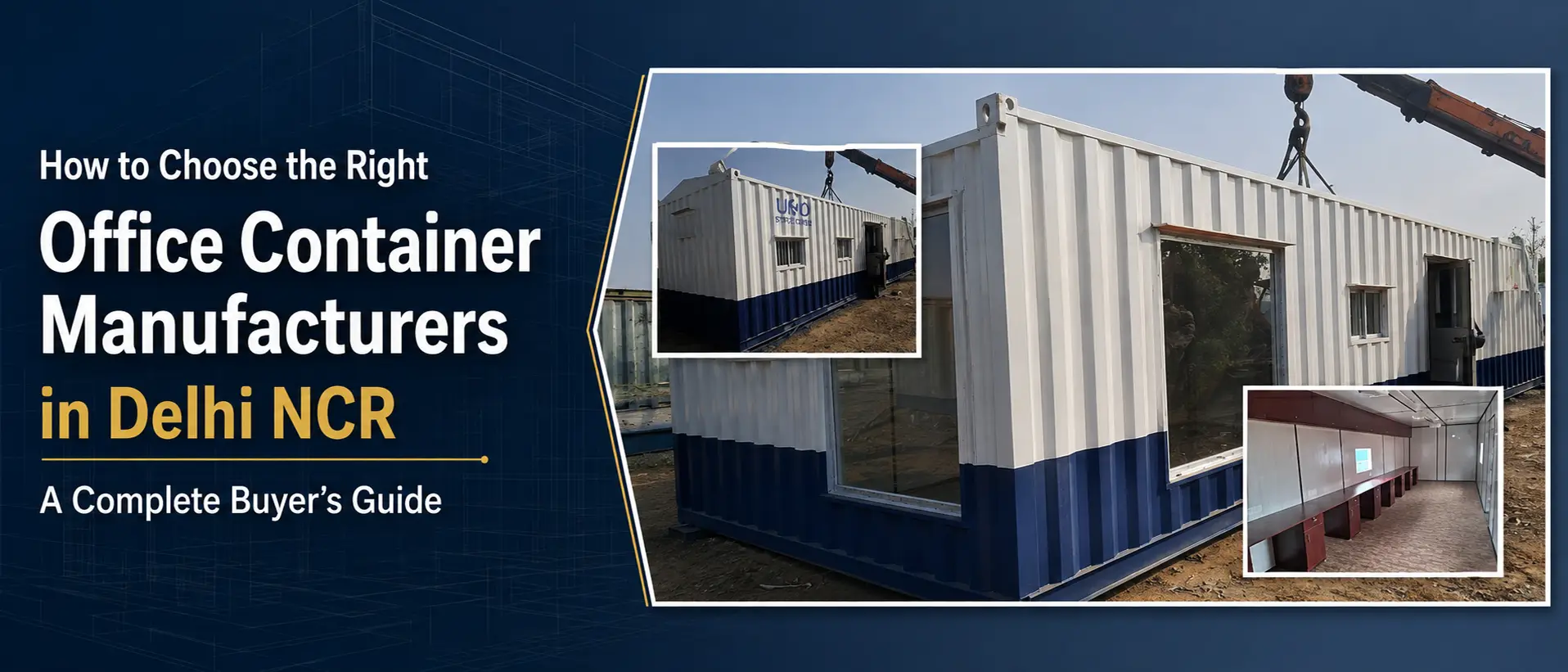
How to Choose the Right Office Container Manufacturers in Delhi NCR: A Complete Buyer’s Guide
Choosing the right office container manufacturers in Delhi NCR involves much more than comparing prices or selecting a standard container size. An office container becomes a functional workplace, so its structural quality, insulation, internal layout, electrical provisions, finishes, transportation, installation, and long-term usability all matter.
For construction companies, industrial businesses, EPC contractors, infrastructure developers, and project teams, containerized offices offer a practical way to create working spaces without depending entirely on conventional on-site construction. They can be manufactured in a controlled environment, transported to the project location, installed relatively quickly, and configured around specific operational requirements.
However, two office containers of similar dimensions can differ significantly in material specifications, thermal comfort, workmanship, utility provisions, and overall project scope. This is why selecting a manufacturer should be based on technical capability and project understanding rather than the lowest quotation alone.
This guide explains what buyers should evaluate when comparing office container manufacturers in Delhi NCR, which specifications deserve attention, what affects office container cost, and which questions should be answered before placing an order.
What Is an Office Container?
An office container is a prefabricated, containerized workspace designed to provide functional office facilities at construction sites, industrial plants, warehouses, infrastructure projects, commercial locations, and other temporary or semi-permanent work environments.
Unlike a conventional office that is constructed almost entirely at the project location, a prefabricated office container is largely fabricated and finished before being transported to the site.
Depending on project requirements, an office container may include:
- Structural steel framework
- Insulated wall and roof systems
- Doors and windows
- Internal partitions
- Electrical wiring and lighting
- Power sockets and distribution provisions
- Air-conditioning provisions
- Finished flooring
- Workstations or cabins
- Storage areas
- Pantry or washroom provisions
- Data and communication points
The exact configuration should depend on how the space will actually be used rather than following a standard layout for every project.
Where Are Office Containers Commonly Used?
Portable office containers are particularly useful where teams need functional working space within a relatively short project timeline.
Common applications include construction site offices, project management offices, engineering cabins, administrative offices, industrial plant offices, warehouse offices, temporary sales offices, infrastructure project offices, security and supervision rooms, and remote-site workspaces.
They can also support expanding facilities where an organization needs additional office space without immediately undertaking extensive conventional construction.
Why Are Businesses Choosing Office Containers in Delhi NCR?
Delhi NCR has a wide mix of construction, infrastructure, warehousing, manufacturing, commercial, and industrial activity. Many such projects require office facilities close to the actual work area.
A portable office container can be useful in these situations because much of the fabrication happens away from the operating site. This can reduce the amount of civil work, material handling, and construction activity required at the final location.
Office containers can also offer flexibility where project requirements change. Depending on their design and installation, units may be relocated, reconfigured, expanded, or reused for another project.
This makes them particularly relevant for organizations whose space requirements are linked to construction schedules, temporary projects, industrial expansion, or changing workforce requirements.
The benefits, however, depend heavily on how well the container has been designed and manufactured. A poorly planned unit can create problems with heat, space utilization, electrical systems, maintenance, or relocation later.
How to Choose the Right Office Container Manufacturer in Delhi NCR
When evaluating an office container manufacturer in Delhi NCR, buyers should look beyond photographs and quoted prices. The manufacturer should be able to translate operational requirements into a practical, technically appropriate container solution.
Here are the most important factors to evaluate.
1. Check the Manufacturer’s Actual Production Capability
Start by understanding where and how the office container will be manufactured.
Ask whether fabrication is handled in-house or outsourced, what production and quality-control processes are followed, and whether the manufacturer has experience handling units similar to your project.
This becomes particularly important when a project involves multiple containers, specialized layouts, tight delivery schedules, or coordination between structural, electrical, interior, and utility work.
A capable manufacturer should be able to explain the manufacturing process clearly rather than simply showing a finished product catalogue.
2. Evaluate Structural Design and Material Quality
An office container needs a structural system capable of handling transportation, installation, regular use, and the environmental conditions at its intended location.
Buyers should understand the specifications for the main frame, wall system, roofing, flooring support, corrosion protection, doors, windows, and external finishes.
Rather than asking only, “How much steel is used?”, ask why a particular structural configuration has been selected for the proposed size and application.
The appropriate specification can vary according to container dimensions, occupancy, transportation requirements, site conditions, and intended service life.
3. Pay Attention to Insulation and Thermal Performance
Thermal comfort deserves particular attention for office containers used across Delhi NCR, where outdoor conditions can vary considerably through the year.
A metal enclosure without suitable thermal planning can become uncomfortable and place unnecessary load on air-conditioning systems.
Discuss the wall and roof insulation system with the manufacturer. Ask about insulation material, thickness, internal lining, roof treatment, ventilation, window placement, and AC provisions.
The goal should be to create a usable workspace, not simply an enclosed steel structure.
4. Plan the Interior Around Actual Occupancy
A common procurement mistake is choosing a container size first and planning the office later.
Instead, start with operational requirements.
How many people will regularly use the office? Do they need individual workstations? Is a manager's cabin required? Will visitors enter the space? Is a meeting room necessary? What about storage, document cabinets, pantry facilities, or washrooms?
These answers determine how effectively the available floor area can be used.
For customized office containers, early space planning can prevent overcrowding and reduce expensive modifications after delivery.
5. Review Electrical and Utility Provisions
Electrical planning should be part of the initial design rather than treated as an afterthought.
Depending on the application, the office may require lighting, power sockets, AC points, distribution boards, networking points, equipment connections, emergency lighting, and external power-entry provisions.
If plumbing is required for a pantry or washroom, the location of water supply, drainage, and fixtures also needs to be coordinated.
Ask the manufacturer exactly which services are included in the quoted scope and which connections must be completed at site.
6. Understand the Available Customization
Not every buyer needs a fully customized office container, but the manufacturer should be able to explain which elements can be modified when the project requires them.
Customization may involve dimensions, internal partitions, doors, windows, flooring, wall finishes, electrical points, furniture provisions, branding, storage, pantry areas, or utility systems.
Customization should solve a functional requirement. Adding unnecessary features simply increases cost and complexity.
A reliable custom office container manufacturer should therefore begin with the intended use of the space rather than presenting customization as a list of optional upgrades.
7. Review Relevant Project Experience
Previous project experience can reveal more than a product brochure.
Look for projects with requirements comparable to yours in terms of size, application, industry, location, or complexity.
If you need a site office for an industrial project, for example, experience with similar site conditions may be more useful than experience producing small standalone cabins for unrelated applications.
Ask how the manufacturer handled layout constraints, transportation, installation, utilities, and site coordination on previous projects.
8. Understand Quality-Control Procedures
Quality should be checked throughout fabrication rather than only when the container is ready for dispatch.
Depending on the scope, checks may include dimensional accuracy, welding and fabrication quality, surface preparation, protective coatings, wall and roof installation, doors and windows, electrical work, flooring, internal finishes, and final functional inspection.
Before dispatch, buyers should clarify whether they can review drawings, specifications, progress photographs, or the completed unit.
9. Evaluate Delivery and Installation Capability
Manufacturing is only one part of an office container project.
The finished unit must reach the project location safely and be positioned correctly.
For projects across Delhi, Noida, Greater Noida, Ghaziabad, Gurugram, Faridabad, and surrounding NCR areas, transportation conditions can vary considerably.
Access roads, gate dimensions, turning radius, overhead restrictions, crane positioning, unloading space, operating-site restrictions, and ground conditions can all influence delivery.
Clarify who is responsible for transportation, unloading, crane arrangements, positioning, installation, and final connections before confirming the order.
10. Compare Complete Scope Instead of Only Price
A low quotation does not necessarily mean a lower project cost.
One supplier may quote only the basic fabricated container, while another includes insulation, internal finishing, electrical work, flooring, transportation, and installation.
Before comparing prices, put competing quotations on the same scope.
This makes it easier to identify exclusions and understand the actual delivered cost of the office container.
What Specifications Should You Check Before Buying an Office Container?
Technical specifications should be documented before manufacturing begins. This reduces misunderstandings and gives both buyer and manufacturer a clear reference.
Specification |
What the Buyer Should Check |
|
Structural frame |
Section type, thickness and suitability for the proposed unit |
|
External walls |
Material, finish and weather protection |
|
Roof |
Roofing system, waterproofing and drainage approach |
|
Insulation |
Material, thickness and location |
|
Flooring |
Base construction, load suitability and finished surface |
|
Doors |
Material, size, location, hardware and security |
|
Windows |
Size, placement, glazing and ventilation |
|
Electrical system |
Lighting, sockets, DB, wiring and AC provisions |
|
Interior partitions |
Layout, material and finish |
|
Ventilation |
Natural or mechanical ventilation requirements |
|
Plumbing |
Water and drainage provisions where required |
|
Interior finish |
Wall, ceiling and floor finishes |
|
External finish |
Protective coating and appearance |
|
Utilities |
Data, communication and other project-specific provisions |
Not every project requires the same specification. The important point is that the agreed specification should be clear enough to compare quotations accurately.
Standard vs Customized Office Containers: Which Should You Choose?
A standard office container can be suitable when requirements are straightforward, delivery speed is important, and the standard layout already supports the intended use.
Customized office containers are more appropriate when the number of occupants, internal workflow, site constraints, utility requirements, or project standards demand a specific configuration.
For example, a small supervision office may only need an open workspace, basic electrical provisions, and air conditioning. A larger project office may require separate cabins, a meeting room, document storage, reception, networking, and pantry facilities.
The right choice therefore depends on operational requirements rather than whether customization is inherently better.
Office Container vs Traditional Site Office
Both approaches can work, but they solve different project requirements.
Factor |
Office Container |
Traditional Site Office |
|
Fabrication |
Primarily off-site |
Primarily on-site |
|
Deployment |
Can be relatively fast after site readiness |
Depends on construction sequence |
|
Site activity |
Reduced compared with conventional construction |
More site-based work |
|
Relocation |
Possible with suitable design |
Generally difficult |
|
Customization |
High within modular constraints |
High |
|
Expansion |
Additional units may be integrated |
Usually requires construction |
|
Reuse |
Often possible |
Limited |
|
Site disruption |
Generally lower |
Typically higher |
The decision should consider project duration, available land, required lifespan, future relocation, site restrictions, budget, and intended quality level.
How Much Does an Office Container Cost in Delhi NCR?
There is no single reliable price for every office container because cost depends on its size, specification, layout, finish, services, and delivery requirements.
The main cost drivers include:
- Container dimensions
- Structural steel specification
- Wall and roofing systems
- Insulation type and thickness
- Flooring
- Number and type of doors and windows
- Internal partitions
- Electrical scope
- Air-conditioning provisions
- Plumbing requirements
- Interior finishes
- Furniture or storage requirements
- Transportation distance
- Crane and unloading requirements
- Installation conditions
- Site accessibility
For this reason, buyers searching for an office container price in Delhi NCR should provide manufacturers with a clear requirement rather than asking for a generic per-unit price.
Why the Lowest Office Container Quote May Not Be the Cheapest
A lower initial quotation can become more expensive if important items have been excluded.
Transportation, unloading, electrical work, insulation, foundations, furniture, AC installation, site connections, or finishing work may appear separately later.
Specification differences can also affect long-term operating and maintenance costs.
The better comparison is therefore total project scope against total delivered cost, not simply the first number on the quotation.
Questions to Ask an Office Container Manufacturer Before Placing an Order
A structured discussion can quickly reveal whether a manufacturer understands the project.
Ask:
- Is fabrication handled in-house?
- What structural specification is proposed for this unit?
- What wall and roof insulation will be used?
- Can the layout be modified for our occupancy and workflow?
- Which electrical provisions are included?
- Are AC, plumbing, data, and utility provisions included or only prepared for?
- What drawings or specifications will be approved before fabrication?
- Is transportation included in the quotation?
- Who will arrange unloading and crane support?
- What site preparation is required before delivery?
- What is the expected manufacturing and delivery schedule?
- What quality checks are completed before dispatch?
- What installation and post-delivery support is available?
Clear answers at this stage can prevent significant confusion later.
Common Mistakes to Avoid When Selecting an Office Container Manufacturer
One of the biggest mistakes is choosing a supplier entirely on price. Other common problems include comparing quotations with different specifications, failing to define occupancy, ignoring thermal insulation, and finalizing the layout without planning electrical or data requirements.
Site logistics are also frequently overlooked.
A container may be manufactured perfectly but still face delays if the delivery vehicle cannot access the intended location or if there is no suitable space for crane positioning and unloading.
Another mistake is leaving responsibilities unclear. Transportation, unloading, foundation preparation, utility connections, and installation should all have defined ownership before dispatch.
Office Container Manufacturer Selection Checklist
Before placing an order, verify:
- Manufacturing and fabrication capability
- Relevant project experience
- Structural specifications
- Wall and roofing systems
- Thermal insulation
- Internal layout
- Occupancy requirements
- Electrical provisions
- AC and ventilation requirements
- Plumbing requirements
- Doors and windows
- Flooring and interior finishes
- Customization requirements
- Quality-control process
- Drawing and specification approval
- Transportation responsibility
- Site accessibility
- Unloading and crane requirements
- Installation scope
- Project schedule
- Warranty and post-delivery support
- Complete quotation and exclusions
A manufacturer that can discuss these areas clearly is generally easier to evaluate than one that focuses only on container size and price.
Why Consider UNO Structures for Office Container Projects in Delhi NCR?
UNO Structures works across prefabricated structures, containerized portable units, and civil and interior design projects. This broader project capability can be useful when an office container requirement involves more than fabrication alone.
An office container often needs coordination between the structural shell, internal space planning, electrical services, finishes, site preparation, utilities, and installation. Looking at these elements together can help create a workspace that is practical after delivery rather than simply complete at the factory.
For project-specific requirements, the discussion should begin with intended use, occupancy, dimensions, location, site conditions, internal layout, utilities, and delivery schedule. These inputs help establish a clearer technical and execution scope before fabrication begins.
Office Container Solutions Across Delhi NCR
Office container requirements across Delhi NCR can differ considerably by project location.
A construction project in Noida or Greater Noida may need temporary site management offices that can later be relocated. An industrial facility in Ghaziabad or Faridabad may need an additional administrative or engineering workspace near the production area. Projects in Delhi or Gurugram may have tighter access, storage, and installation restrictions.
This is why geographic proximity alone should not determine the manufacturer.
The better question is whether the supplier can understand the specific site, coordinate transportation and installation, and manufacture a container suited to its actual operating environment.
Frequently Asked Questions About Office Container Manufacturers in Delhi NCR
How do I choose the best office container manufacturer in Delhi NCR?
Compare manufacturers based on fabrication capability, structural specifications, insulation, customization, quality control, relevant project experience, delivery capability, installation support, and total scope. Avoid making the decision solely on the lowest quotation.
How much does an office container cost in Delhi NCR?
Office container cost varies according to size, structural specification, insulation, interior layout, electrical work, flooring, plumbing, finishes, transportation, and installation. A project-specific quotation is more reliable than a generic price.
Can an office container be customized?
Yes. Depending on manufacturing capability, office containers can be configured with different layouts, partitions, doors, windows, electrical systems, flooring, storage, workspaces, pantry areas, and other project-specific features.
How long does it take to manufacture an office container?
Manufacturing time depends on size, quantity, customization, material availability, production workload, approvals, and finishing requirements. Buyers should confirm the production and delivery schedule for their specific project before ordering.
What materials are used for office containers?
Materials vary by manufacturer and specification. Office containers generally use a structural steel framework combined with wall and roof systems, insulation, flooring, doors, windows, electrical components, and interior finishing materials.
Are office containers suitable for Delhi NCR weather?
They can be, provided thermal performance, insulation, ventilation, weather protection, waterproofing, and air-conditioning requirements are considered during design and manufacturing.
What size office container should I choose?
Choose the size according to occupancy, furniture, circulation space, cabins, meeting requirements, storage, utilities, and available site area. Planning the internal layout before finalizing dimensions usually produces better results.
What should be included in an office container quotation?
A detailed quotation should identify structural specifications, wall and roof systems, insulation, flooring, doors, windows, electrical scope, interior finishes, utilities, transportation, unloading, installation, taxes where applicable, delivery schedule, and exclusions.
Choosing the Right Office Container Partner for Your Project
Finding the right office container manufacturers in Delhi NCR is ultimately about finding the right balance between structural quality, workplace functionality, project cost, and execution capability.
Before requesting quotations, define how the office will be used, how many people it must accommodate, what utilities are required, where it will be installed, and whether it may need to be relocated later. Then compare manufacturers against the same technical and commercial scope.
This approach makes it easier to distinguish between a low initial quotation and a genuinely suitable project solution.
If you are planning an office container for a construction site, industrial facility, infrastructure project, warehouse, or other project location in Delhi NCR, connect with UNO Structures with your required dimensions, expected occupancy, preferred layout, utility requirements, project location, and delivery schedule. The team can help evaluate the container configuration, technical requirements, interior planning, and execution scope so that your office space is planned around the way your project actually needs to operate.
Contact UNO Structures to discuss your project requirement, customization scope, operational environment, and deployment planning.
Learn more about UNO Structures